

Why smarter network planning, professional site surveys, and expert implementation make all the difference.
Picture this: A hotel guest struggles to connect to Wi-Fi in their room. A student can’t maintain a stable connection during an online exam. A conference attendee loses connectivity in the middle of an important presentation. Different environments, different frustrations, one common problem: a network that isn’t meeting the demands placed on it.
When connectivity issues arise, it’s tempting to assume that installing additional access points will solve the problem. But without understanding what’s causing poor performance, adding more hardware can create new challenges instead of solving existing ones.
Overlapping wireless coverage, interference, insufficient network capacity, and poorly planned infrastructure can all contribute to unreliable connectivity.
Great Wi-Fi isn’t just about how many access points you have. It’s about how effectively your entire network works together.
At SolutionInc, we believe reliable connectivity starts long before you install the first access point.
Our Professional Wi-Fi & Network Services help organizations assess their existing infrastructure, design networks around their specific needs, and coordinate deployments that support long-term performance.
Here’s how we approach building better networks.
Step 1: Network Assessment & Site Surveys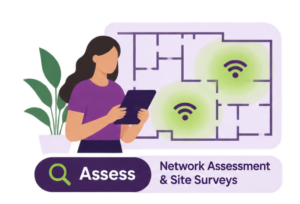
Before you can improve your network, you need to understand it.
No two buildings are exactly alike, and neither are their connectivity challenges.
A historic hotel with thick concrete walls presents different obstacles than a modern student residence. A conference centre supporting hundreds of simultaneous connections requires a different approach than an office building with predictable daily traffic.
Even within the same property, connectivity requirements can vary dramatically from one area to another.
Consider a hotel. Guest rooms need consistent coverage, conference spaces require capacity for large groups, and operational areas may depend on connectivity for essential systems.
A network designed without accounting for these differences can leave users frustrated and operations disrupted.
That’s why a thorough network assessment is one of the most important steps in building a reliable wireless environment.
What does a network assessment actually involve?
A professional assessment looks beyond whether a Wi-Fi signal is available. It examines the factors influencing the network’s overall performance and its ability to support users.
Depending on the environment and project requirements, this can include:
- Wireless coverage: Identifying weak signal areas, coverage gaps, and potential sources of interference.
- Existing infrastructure: Reviewing networking equipment, cabling, and other components that may affect performance.
- Network capacity: Evaluating how well the network can accommodate current and anticipated device demands.
- Building characteristics: Considering layouts, construction materials, and physical obstacles that influence wireless signals.
- Operational requirements: Understanding how employees, guests, residents, and connected systems rely on the network.
These insights help uncover issues that might otherwise go unnoticed until they begin affecting users.
Why does this matter?
Imagine investing in additional access points to improve coverage, only to discover that the real issue is interference or an overloaded network connection.
Without an assessment, businesses risk spending money on solutions that don’t address the underlying problem.
SolutionInc’s network assessments and professional site surveys help organizations make more informed infrastructure decisions by identifying existing challenges and opportunities for improvement.
The result: A clearer understanding of your network, actionable recommendations, and a practical foundation for the next stage.
Step 2: Network Design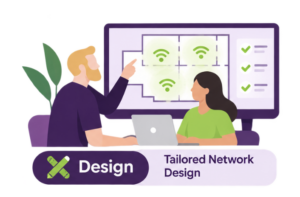
Design a network around your environment, not the other way around.
Once you understand your network’s challenges and requirements, the next step is developing a plan that addresses them.
This is where network design separates simply providing connectivity from building an infrastructure that supports your business.
Think about how dramatically Wi-Fi demands can differ across industries.
In hospitality, guests expect reliable connectivity throughout their stay, from their rooms to shared spaces. Meanwhile, hotel operations may depend on network access for property management systems, connected devices, and staff communications.
In student housing, residents may attend virtual classes, stream entertainment, play online games, and connect multiple personal devices at the same time. Networks need to accommodate these demands without sacrificing the experience of other residents.
In conference and event venues, network usage can change dramatically depending on the event. A relatively quiet venue one day might need to support thousands of devices the next.
In commercial properties, reliable connectivity can support everything from employee productivity to building management systems and tenant services.
Each environment requires a thoughtful approach to coverage, capacity, infrastructure, and scalability.
What goes into a strong network design?
Effective network design considers more than where to install access points.
It requires understanding how different network components work together to deliver the experience users expect.
At SolutionInc, our network design services focus on several important areas:
1. Choosing the right equipment
Not every networking product suits every environment. Selecting appropriate equipment means considering performance requirements, compatibility, reliability, and budget.
2. Planning for coverage and capacity
A strong wireless signal is only part of the equation. Networks must also be designed to accommodate the number of devices, applications, and users they are expected to support.
3. Considering the entire infrastructure
Access points, switches, gateways, cabling, and other network components all affect overall performance. Effective design considers how these elements operate together.
4. Preparing for future growth
The network that meets your needs today may face entirely different demands in a few years.
As properties expand, technology evolves, and users connect more devices, network infrastructure must adapt.
Planning for scalability from the beginning can help reduce the need for costly infrastructure changes later.
5. Maximizing the value of your investment
A well-designed network helps organizations make strategic decisions about where to invest, what infrastructure to reuse, and which improvements will provide the greatest benefit.
Designing for today and tomorrow
One of the biggest mistakes organizations can make is designing a network solely around their immediate needs.
Connectivity demands rarely remain static.
A student residence might introduce new smart-building technologies. A hotel may expand its guest services. A conference venue could begin hosting larger events with more demanding connectivity requirements.
By considering these possibilities during the design stage, organizations can build a stronger foundation for future growth.
The result: A tailored network design that balances performance, operational requirements, scalability, and budget.
Step 3: Network Implementation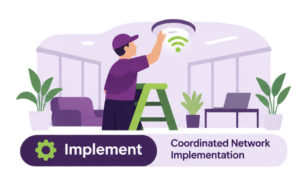
Even the best network design needs the right execution.
You’ve assessed your environment, identified your requirements, and developed a network design.
Now comes the part where everything needs to work together.
Network implementation can involve far more than installing equipment.
Depending on the project’s scale, deployments may require coordination among equipment vendors, installation teams, property management, IT departments, and other stakeholders.
Operational constraints may also require consideration.
A hotel might need to upgrade its network without significantly disrupting guests. A student residence may have a narrow installation window before residents move in. A conference venue may need to work around a busy event schedule.
These factors make project coordination essential to a successful deployment.
Bringing the plan to life
SolutionInc’s experienced project managers coordinate and oversee Wi-Fi and network deployments, ensuring each stage of implementation aligns with the larger project goals.
Our approach focuses on:
- Project coordination: Helping align vendors, installation teams, stakeholders, and project requirements.
- Deployment planning: Organizing implementation activities around project timelines and operational considerations.
- Infrastructure integration: Considering how new networking components fit within the overall environment.
- Quality and consistency: Helping ensure implementation aligns with the intended network design.
- End-to-end oversight: Taking a holistic view of the deployment rather than treating each stage as an isolated task.
The objective isn’t simply to install equipment.
It’s to help organizations move from a carefully developed network design to an operational solution with fewer complications and greater confidence.
Why implementation matters just as much as design
Imagine a network designed with carefully calculated access point placement.
If equipment is installed in different locations than planned, wireless coverage and performance may suffer.
Similarly, delays in equipment availability, incomplete infrastructure preparation, or poor coordination between vendors can disrupt deployment schedules.
Proper project management helps identify and address these challenges throughout implementation.
By connecting planning and execution, organizations are better positioned to achieve the results their network was designed to deliver.
The result: A professionally coordinated deployment that helps bring your network design to life.
The Bigger Picture: Why Network Planning Is Worth the Investment
The cost of poor Wi-Fi goes beyond a weak signal.
When connectivity fails, the consequences can extend far beyond temporary inconvenience.
For a hotel, unreliable Wi-Fi can lead to guest complaints and negative reviews.
For student housing operators, recurring connectivity problems can frustrate residents and drive additional support requests.
For businesses, network interruptions can affect productivity and access to essential applications.
And for conference venues, poor connectivity can disrupt events and affect the experience of attendees and organizers.
While the impact varies by industry, the underlying message is the same:
Your network isn’t just another piece of infrastructure. It’s part of the experience you deliver.
Investing in proper network assessment, design, and implementation can help organizations:
- Reduce avoidable connectivity issues by identifying potential problems early.
- Make smarter infrastructure investments based on actual network requirements rather than assumptions.
- Improve user experiences through more thoughtful coverage and capacity planning.
- Support operational continuity with infrastructure designed around business needs.
- Prepare for future demands without continually starting from scratch.
And perhaps most importantly, it gives organizations a clearer strategy for managing one of their most essential technology investments.
Your Network. Our Expertise.
Better connectivity starts with better decisions.
No universal formula exists for building the perfect network.
Every property has its own layout, infrastructure, operational requirements, and connectivity expectations.
What works for one environment may not work for another.
That’s why SolutionInc takes a tailored approach to professional Wi-Fi and network services.
With more than 25 years of experience in Wi-Fi and network management, our team understands the importance of getting the fundamentals right.
From evaluating existing infrastructure and developing network designs to coordinating implementation, we help businesses navigate the complexities of building and improving their networks.
Because the goal isn’t simply to install more technology.
It’s to build a network that works better for the people who depend on it.
Ready to Build a Better Network?
Whether you’re planning a new deployment, upgrading aging infrastructure, or solving recurring Wi-Fi challenges, the right plan can make all the difference.
Let’s build a stronger connection.